

Immigrants & Refugees in Guilford County
Posted on February 06, 2020

Posted on February 06, 2020
Posted on February 06, 2020

Posted on February 07, 2020

Posted on March 04, 2020

Posted on March 19, 2020

Addressing the intertwined issues of housing affordability and healthy living environments calls for a coordinated, multi-prong, systemic approach; one that brings together community members, developers, state and local governments, health care providers, philanthropy advocates, and other stakeholders. North Carolina has the opportunity to change the current system that has resulted in zones of exclusion and concentrations of poverty. Effective public-private partnerships can support and implement a range of policy and practice recommendations.

Posted on March 27, 2020
By Craig Howard, Community Relations-Development Manager, Spokane Neighborhood Action Partners (SNAP)
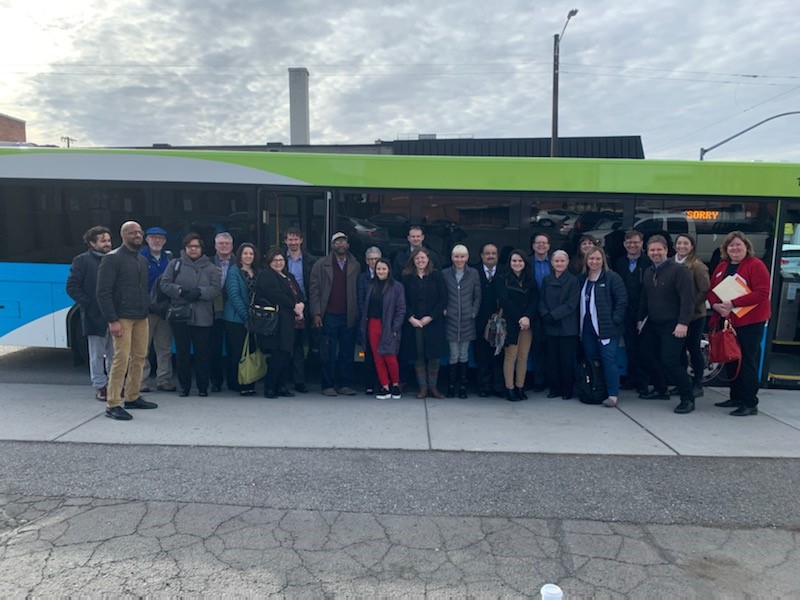
The gathering in Spokane lasted less than three full days but the positive impact is still reverberating in places like Greensboro, North Carolina and Grand Rapids, Michigan.
On Feb. 25-27, Spokane hosted an Invest Health conference that took the shape of a dynamic brainstorming session on affordable housing, community health and the benefits of public/private partnerships. For attendees like Dr. Stephen Sills, director of the Center for Housing and Community Studies at the University of North Carolina-Greensboro, the gathering was well worth the nine-hour round trip by plane.
“It was the strategic outcome we had hoped for,” said Sills. “Spokane for us was a catalyst. It showed us that public housing can play a central role in convening the continuum of care. It was a reminder that you can stay compliant and address needs and also be creative in public/private partnerships.”
Greensboro, Grand Rapids and Spokane are among 50 U.S. cities to receive grants from the Robert Wood Johnson Foundation to address affordable housing and its intersection with health. The foundation also selected 10 communities from the 50 to participate in summits like the one held in Spokane.
 The Robert Wood Johnson Foundation and the Reinvestment Fund are partnering on Invest Health, described on the Reinvestment Fund website as “a new initiative that brings together diverse leaders from mid-sized U.S. cities to develop new strategies to increase and leverage private and public investment and accelerate improvements in neighborhoods facing the biggest barriers to better health.”
Both Grand Rapids and Greensboro have populations similar to Spokane while all three cities face parallel challenges when it comes to housing – a dwindling supply of affordable multi-family and single-family units, rising property values and scarce home ownership opportunities for lower-income residents.
Locally, SNAP serves as the fiscal agent for the grant with Cameryn Flynn, SNAP’s Ride to Health coordinator, acting as Invest Health project manager. In addition to SNAP, local partners include Volunteers of America, Catholic Charities, Spokane Transit Authority (STA), the city of Spokane and the Spokane Housing Authority.
Flynn said last month’s conference spotlighted Spokane’s unique emphasis on collaboration.
“It showed how a city of our size has such good partnerships and how everyone works together,” Flynn said. “Those who came here were definitely impressed with the way the Spokane Housing Authority works with the community to successfully increase housing vouchers.”
The Greensboro contingent included representation from the health sector, higher education, private development, the city of Greensboro and the Greensboro Housing Coalition. Sills said one change that has occurred since the conference is that referrals are now being made to the Greensboro Housing Coalition in cases of possible evictions for financial reasons.
“That came about from a side conversation we had over dinner in Spokane,” Sills recalls. 
Jeremy DeRoo is the executive director of a nonprofit in Grand Rapids that develops affordable housing and specializes in community organizing. He said the conference served “as a reminder that local leadership matters and that collaborative spirit can make a difference.”
“I was impressed with the ability of the (Spokane) Housing Authority to efficiently allocate resources through partnerships,” DeRoo said. “We were able to see how collaboration is working in Spokane to address affordable housing issues.”
Posted on July 02, 2020

A White Paper by Bruce Rich, Center for Housing & Community Studies
Before the pandemic, Greensboro’s renters were being evicted at an alarming rate, and this was in an economic environment marked by years of expansion and low unemployment. Sustained strong economic activity, though great for some, drove rents up in Greensboro and vacancy rates down. Renters increasingly were forced to pay an unreasonable percentage of their income on housing expense, and forced to settle for substandard conditions or to cut food or medicine. As a result, Greensboro in recent years was deep into an eviction crisis, with well above four evictions per hundred rental homes, the worst rate in North Carolina and seventh worst in the country.That was then. But in 2020 the COVID-19 crisis struck, shattering that strong economy. The abrupt imposition of stay-at-home orders throughout the country shut down businesses and led to sudden, catastrophic job losses. North Carolina was hard hit. Over a million new unemployment claims were filed since March 14, representing 21.2% of the workforce. Women, Latinx people, immigrants, young workers and those with less education were most vulnerable to layoffs, and those groups are among the most precariously housed already. This has the potential to turn an eviction crisis into an “avalanche of evictions.”
REGISTER FOR THE HOUSING HANGOUT:
Posted on July 02, 2020

Tatiana Height (Project Coordinator) and Stephen Sills (PI)
UNC-Greensboro Center for Housing and Community Studies
Direct Correspondences to: tcheight@uncg.edu
This community engaged project with residents of the Cottage Grove neighborhood in East Greensboro, NC will address environmental justice concerns with two unnamed tributaries of South Buffalo Creek. We will involve the residents through an oral history of long-time residents (>20 years), as well as surveys, focus groups, participatory community meetings, community work days with university student volunteers, and finally an educational citizen science stormwater campaign with K-6 students. We expect the main outcome of the project is to build community capacity to organize and advocate for resources like green infrastructure through the City of Greensboro’s Participatory Budgeting process. The residents will build relationships with the City of Greensboro’s environmental educators and those relationships build trust in government and can help connect them to other resources in the community. Another outcome will be the development of a tool kit for other communities to do similar community-engaged work around stormwater. The project will also initiate an environmental educational program with K-6 students, which will have a continuing impact as the water quality and stream studies become part of the curriculum for students. The results of the surveys will provide the Stormwater Group rich information about how this community views their undeveloped/natural areas and how they would like to see them improved as well as how much the community engagement activities changed their outlook about the neighborhood over the two-year project.
Posted on July 02, 2020

With COVID-19 forcing millions of Americans into unemployment and temporary eviction moratoria about to expire as emergency orders end, renter households are in jeopardy of evictions. This webinar will highlight how two different regions of the country are taking preventative action to help residents prepare for the eviction cliff and avoid housing displacement.
Featured panelists:
The Honorable Dean Dafis, Deputy Mayor, City of Maplewood, NJ
Khabirah H. Myers, Esq., Office of Tenant Legal Services, City of Newark, NJ
Stephen J. Sills, PhD, Director, Center for Housing and Community Studies, University of North Carolina at Greensboro
View the recording at: https://attendee.gotowebinar.com/recording/8365907306651201288
Posted on July 16, 2020

 Buffalo Creek’s s first workday took place on June 20th in the Cottage Grove neighborhood with a great turnout. The project’s goal of improving the environmental conditions of the quality of water in the creek seems to be right on track.
Community volunteers got involved by picking up nearly 25 bags of litter, a misplaced shopping cart, and a trashed mattress frame. Among the environmental education, snacks and work supplies provided, everyone who came out enjoyed their time contributing to local efforts. Some of whom, are looking forward to the next workday.