Posted on February 08, 2021

Featured Image for Payton Foh awarded inaugural CHCS Faculty Research Fellowship

Dr. Erica Payton Foh in Public Health Education is the Center for Housing and Community Studies’ inaugural Faculty Research Fellow.

The yearlong fellowship supports one faculty member per year who is pursuing community-engaged, impactful, and innovative public scholarship related to the Center’s mission.

Dr. Payton Foh’s research focuses on violence prevention. Her work seeks to understand the current perceptions of the causes, consequences, and prevention of violence at the individual, community, and societal level.

“What stood out to me most about the opportunity to be a CHCS Research Fellow was the intentional design of the fellowship to support community-engaged scholars in building and sustaining mutually beneficial community partnerships,” says Dr. Payton Foh.

Throughout this year, Dr. Payton Foh will be working with the center on applied community-engaged projects focused on the assessment and development of community-based solutions. One major project will explore the impact of COVID-19 on neighborhood violence in the Dan River region. The goal of the project is to examine which neighborhood and community characteristics increase the risk for violence, including domestic violence, gun violence, and suicide.

“Now, as society continues to wrestle with a pandemic, continued racial injustices, and increased concern over safety and wellbeing, addressing violence as a public health issue is all the more paramount,” she adds. “I strongly believe that together we are better. I look forward to collaborating on meaningful and timely research with community partners and the CHCS team.”

Posted on February 23, 2021

Featured Image for Exclusion by Design

One of the best ways for families to pass down wealth is through home equity. However, home ownership has been unattainable for many African Americans. Historical discriminatory lending regulations have led to systemically-ingrained segregation through the zoning practice of “redlining.”

Click here for the CHCS PowerPoint: Redlining Gentrification and its Impacts

Watch the panel session:

Posted on March 04, 2021

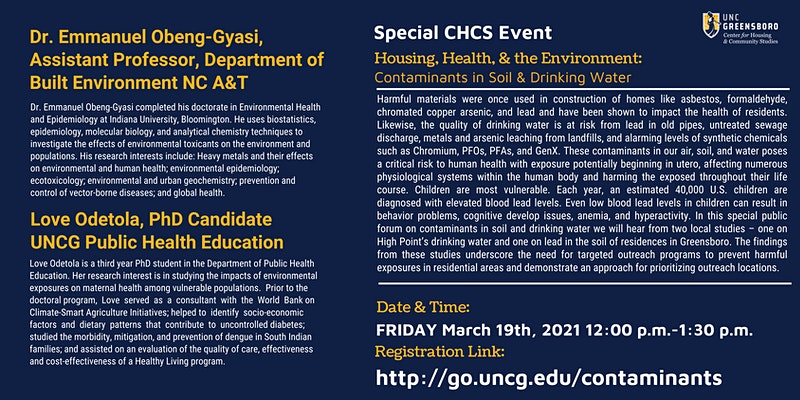
Featured Image for Special Event – Contaminants in Soil & Drinking Water

Findings from recent research on soil lead exposure risk in Greensboro & contaminants in residential tap water in High Point.

FRIDAY MARCH 19th NOON

REGISTER AT: http://go.uncg.edu/contaminants

Harmful materials were once used in construction of homes like asbestos, formaldehyde, chromated copper arsenic, and lead and have been shown to impact the health of residents. Likewise, the quality of drinking water is at risk from lead in old pipes, untreated sewage discharge, metals and arsenic leaching from landfills, and alarming levels of synthetic chemicals such as Chromium, PFOs, PFAs, and GenX. These contaminants in our air, soil, and water poses a critical risk to human health with exposure potentially beginning in utero, affecting numerous physiological systems within the human body and harming the exposed throughout their life course. Children are most vulnerable. Each year, an estimated 40,000 U.S. children are diagnosed with elevated blood lead levels. Even low blood lead levels in children can result in behavior problems, cognitive develop issues, anemia, and hyperactivity. In this special public forum on contaminants in soil and drinking water we will hear from two local studies – one on High Point’s drinking water and one on lead in the soil of residences in Greensboro. The findings from these studies underscore the need for targeted outreach programs to prevent harmful exposures in residential areas and demonstrate an approach for prioritizing outreach locations.

Speakers:

Housing, Health, and the Environment: Contaminants in Soil & Drinking Water image
Dr. Emmanuel Obeng-Gyasi, Assistant Professor, Department of Built Environment, NC A&T.


Presenting from his recent publication:

Obeng-Gyasi, E., Roostaei, J., and MacDonald Gibson, J. (2021) “Lead Distribution in Urban Soil in a Medium-Sized City: Household-Scale Analysis.” Environmental Science & Technology. https://doi.org/10.1021/acs.est.0c07317

Housing, Health, and the Environment: Contaminants in Soil & Drinking Water image
Love Odetola, PhD Candidate , Public Health Education, UNCG.


Presenting from her recent publication:

Odetola, L., Sills, S., and Morrison, S. (Forthcoming) “A Pilot Study on the Feasibility of Testing Residential Tap Water in North Carolina: Implications for Environmental Justice and Health.” Journal of Exposure Analysis and Environmental Epidemiology (under review).


Posted on March 04, 2021

Featured Image for CHCS March 2021 Newsletter

Posted on March 05, 2021

Featured Image for Housing Hangout – Greensboro Builders
The cost of housing has skyrocketed as demand has increased, material costs have risen, and labor supply has become limited.

The cost of housing has skyrocketed in recent years. Low interest rates for mortgages and refinancing combined with a short supply of housing in the market has led to high demand for remodeling as well as new housing starts. But, the material cost to build a house has increased as materials used in construction are in short supply. Lumber just this past week topped $1,000 per 1,000 board feet. According to the Urban Institute, labor cost and availability are also key contributors to the high cost of construction. Other major challenges facing the construction industry are an aging workforce of skilled tradespersons, a dearth of younger workers seeking jobs in construction trades, work place safety concerns, and uncertainty over immigration policies that have left many builders with a shortage of labor. In this month’s Housing Hangout, we will discuss all things construction with local builders from the Greensboro Builders’ Association and housing rehab specialists from Community Housing Solutions.

Speakers:

Will Yearns is president of Granville Homes LLC, a residential development and construction company building homes throughout Greensboro, Guilford and surrounding counties. Will is serving this year as president of the Greensboro Builders Association, a 600+ member trade association representing residential and commercial builders and remodelers, suppliers, trade contactors and service providers.

Phil Warrick is president of Piedmont Wholesale Engineered Products and Certified Repair, Inc. Phil has more than 35 years of experience in the building industry. He currently serves as a national delegate with the National Association of Homes Builders, chairing their Resolutions Committee and serving as Vice Chair of Custom Builders Council. Phil has served as the president of both the Greensboro Builders Association and the NC Home Builders Association.

Jim Sandknop is Director of Construction Operations with Community Housing Solutions, a local non-profit organization that provides home repairs to homeowners in Guilford County as well as new home construction for first time buyers. With a skilled construction staff and volunteer groups from the community, CHS works with homeowners who fall below specific income levels to make needed repairs making their homes warmer, drier and safer. CHS also provides new home construction for 1st time low income buyers in Greensboro and High Point. Jim has more than 35 years of experience in the building industry, serving as a general contractor.

Posted on March 13, 2021

Featured Image for A Racialized History of Greensboro

Recording of Greensboro Faith Leaders Council meeting featuring a presentation by Dr. Stephen Sills from the Center for Housing and Community Studies at UNC Greensboro entitled Poverty and Community Disparities: A Racialized History of Greensboro.

Posted on March 25, 2021

[widgetkit id=”10″ name=”March Stormwater”]

Our March Community Workday was one of our most engaging and notable Workdays yet. On March 20th, volunteers as young as 4 years old, as well as eager community residents got involved to support environmental justice efforts at Buffalo Creek. Thirty community volunteers from the Health Impact Team at CHCS, NC A&T student volunteers, neighborhood residents, City official Sharon Hightower and staff from the Cottage Garden’s Resource Center.

The workday is intended to raise awareness of environmental justice issues, draw attention to the importance of storm water systems, and improving the environmental conditions of the creek. The workday is part of a larger program sponsored by a grant from the Water Resources Research Institute of the UNC System.

Together we collected over 30 bags of litter, retrieved two shopping carts from the creek, and collected many miscellaneous items like CD’s, Old Cellphones, PVC Pipe, etc. Volunteers took part in a friendly competition for the “most interesting” item and winners received visa gift cards to celebrate their win.

We are looking forward to the next workday in June, 2021. You can RSVP here: https://www.eventbrite.com/e/community-workday-tickets-132269069347


Posted on April 05, 2021

Featured Image for CHCS APRIL 2021 Newsletter

Posted on April 09, 2021

Posted on April 09, 2021

Featured Image for Assessment of Civil Legal Needs in North Carolina

The North Carolina Equal Justice Alliance is a community of civil legal aid providers serving low-income and underrepresented constituencies. Many Alliance members also promote policy initiatives to improve the lives of those who face systemic barriers or are impacted by poverty.  The mission of the Equal Justice Alliance is to provide central coordination of a sustained, comprehensive, integrated, statewide system to provide the most effective legal services to people in poverty in North Carolina.

In 2020, in partnership with UNC Greensboro’s Center for Housing and Community Studies, the NC Equal Access to Justice Commission (EATJC) and the Equal Justice Alliance (EJA) completed the first comprehensive civil legal needs assessment in nearly two decades. The study provides an overview of the scope of civil legal needs in North Carolina, as well as the factors affecting the depth and type of civil legal problems people experience.

The North Carolina Civil Legal Needs Assessment is now live!
View the results here.