Posted on October 11, 2016

Featured Image for The Deficit of Healthy and Affordable Housing in Greensboro

Demand for affordable housing in Greensboro is high, yet, the aging and substandard housing stock does not meet the demand leading to a crisis.

Unfortunately, as we have seen the private investment market cannot take care of all the needs for affordable house in Greensboro. It takes public-private partnerships. We need to continue proactively and affirmatively promoting fair, healthy, and affordable housing in Greensboro for all. We need more low-cost housing in high opportunity neighborhoods. The evidence from a history of building assisted housing in already poor neighborhoods shows that it does not work. We need mixed income development to be encouraged by policy makers and made real by developers. Yet, we need to be careful about gentrification. The approach to ‘fixing’ segregation has often been to declare low-income black neighborhoods as blight and then redevelop them. In the process the residents are priced out of their neighborhoods.

According to senior research associates Rebecca Cohen and Keith Wardrip at the Center for Housing Policy, “affordable housing does more than improve the quality of life for local residents – it strengthens the local economy by creating jobs and fortifying a community’s tax base. Providing affordable housing also yields economic benefits to local employers by making it easier to attract and retain workers.”

If a majority of voters cast a “yes” vote for the bond, Greensboro will have some of the resources needed to address the affordability gap in our City.

More at WHAT’S DRIVING THE AFFORDABLE HOUSING DEFICIT IN GREENSBORO?

Posted on October 03, 2016

Featured Image for #Yes4AffordableHousing – Pests and Respiratory Illness

April Richard, with the Greensboro Housing Coalition, discusses the link between pests and respiratory illness that can affect your neighborhood.

Posted on October 03, 2016

Featured Image for #Yes4AffordableHousing – Aging In Place

Gene Brown with Community Housing Solutions discusses the community benefits of investing in safe homes for aging in place.

Posted on October 03, 2016

Featured Image for #Yes4AffordableHousing – Asthma

Local Pediatric Asthma Specialist, Dr. Bratton, discusses the ways in which substandard housing effects asthma in children.

Posted on September 26, 2016

Featured Image for UNCG Habitat Chapter

Eight members of the Habitat chapter at UNCG gathered together on Saturday, Sept. 24th to frame walls and place roof trusses up for a new home. Habitat is a new chapter at UNCG sponsored by the Center for Housing and Community Studies. Francheska Elliott, one of the Habitat Chapter members stated, “It was a great learning experience and an excellent team building event.”

Posted on May 17, 2016

Featured Image for Greensboro to join innovative, national program to improve health in low-income neighborhoods

Greensboro named one of 50 Invest Health

FOR IMMEDIATE RELEASE

Contact

Dr. Stephen J. Sills, Director of the UNCG Center for Housing and Community Studies, 336.944.6145, chcs@uncg.edu

Greensboro named one of 50 Invest Health cities by Reinvestment Fund and Robert Wood Johnson Foundation

Greensboro to join innovative, national program to improve health in low-income neighborhoods
Greensboro, May 17, 2016 — Greensboro is one of 50 cities selected to take part in a new, national community health focused initiative. As part of the program, Greensboro will address the city’s pediatric asthma rate, which disproportionately affects low-income children.

Invest Health, a collaboration of the Reinvestment Fund and the Robert Wood Johnson Foundation, aims to transform how leaders from mid-size American cities work together to help low-income communities thrive, with specific attention to community features that drive health, such as access to safe and affordable housing.

A team representing the City of Greensboro, Cone Health, East Market Street Development Corporation, Greensboro Housing Coalition and The University of North Carolina at Greensboro (UNCG) applied for grant funding to improve the availability of safe, affordable housing for families living with asthma.

The team’s proposal was selected from 180 proposals representing 170 different cities across the nation. Over the next 18 months, Greensboro’s Invest Health team will receive a $60,000 grant, take part in a vibrant learning community and have access to highly skilled faculty advisors and coaches who will guide their efforts toward improved health.

“Greensboro’s asthma rate is influenced by higher than average poverty and uninsured rates,” explained Dr. Stephen Sills, director of the UNCG Center for Housing and Community Studies.

More than 19,000, or 29.3 percent, of children in Greensboro live in households below the poverty level, and a majority of those homes are not safe for children with asthma.

“These families have few options in terms of affordable and healthy housing, which consigns over 6,000 children with asthma to live in places that make them sick,” Sills said. “Strong evidence has linked plumbing or roof leaks, inadequate ventilation, faulty or inoperative exhaust systems, unclean floors and other surfaces, presence of rodents or cockroaches and building structure issues to subsequent asthma incidence and morbidity.”

Mid-size American cities face some of the nation’s deepest challenges with entrenched poverty, poor health and a lack of investment. But they also offer fertile ground for strategies that improve health and have the potential to boost local economies.

“Our goal is to transform how cities approach tough challenges, share lessons learned and spur creative collaboration,” said Amanda High, chief of strategic initiatives at Reinvestment Fund.

Greensboro’s Invest Health projects will explore a broad range of ideas, from leveraging relationships with the health system to connect affected patients’ families with community action planning, to aligning Invest Health efforts with existing housing improvement projects such as Housing Our Community.

The local team is represented by Cynthia Blue, City of Greensboro; Rev. Beth McKee-Huger, a community housing advocate; Kathy Colville and Jasmin Hainey, Cone Health; Dr. Patrick Wright, Cone Health Medical Group; Mac Sims, East Street Market Development; Brett Byerly and April Richard, Greensboro Housing Coalition; Dr. Tom Wall, Triad HealthCare Network, and Dr. Kenneth Gruber and Dr. Stephen Sills, UNCG.

Project teams will travel to Philadelphia for a kick-off meeting on June 7 and will meet regularly to share lessons learned throughout the 18-month project.  A full list of awardees and more information is available at www.investhealth.org.

###

About Reinvestment Fund

Reinvestment Fund is a catalyst for change in low-income communities. We integrate data, policy and strategic investments to improve the quality of life in low-income neighborhoods. Using analytical and financial tools, we bring high-quality grocery stores, affordable housing, schools and health centers to the communities that need better access—creating anchors that attract investment over the long term and help families lead healthier, more productive lives. Learn more at reinvestment.com.

About the Robert Wood Johnson Foundation

For more than 40 years the Robert Wood Johnson Foundation has worked to improve health and health care. We are striving to build a national Culture of Health that will enable all to live longer, healthier lives now and for generations to come. For more information, visit www.rwjf.org. Follow the Foundation on Twitter at www.rwjf.org/twitter or on Facebook at www.rwjf.org/facebook.

Posted on April 19, 2016

Featured Image for Identifying Opportunities: Geospatial Analysis as a tool for targeted redevelopment

Rachel Ryding, Research Assistant

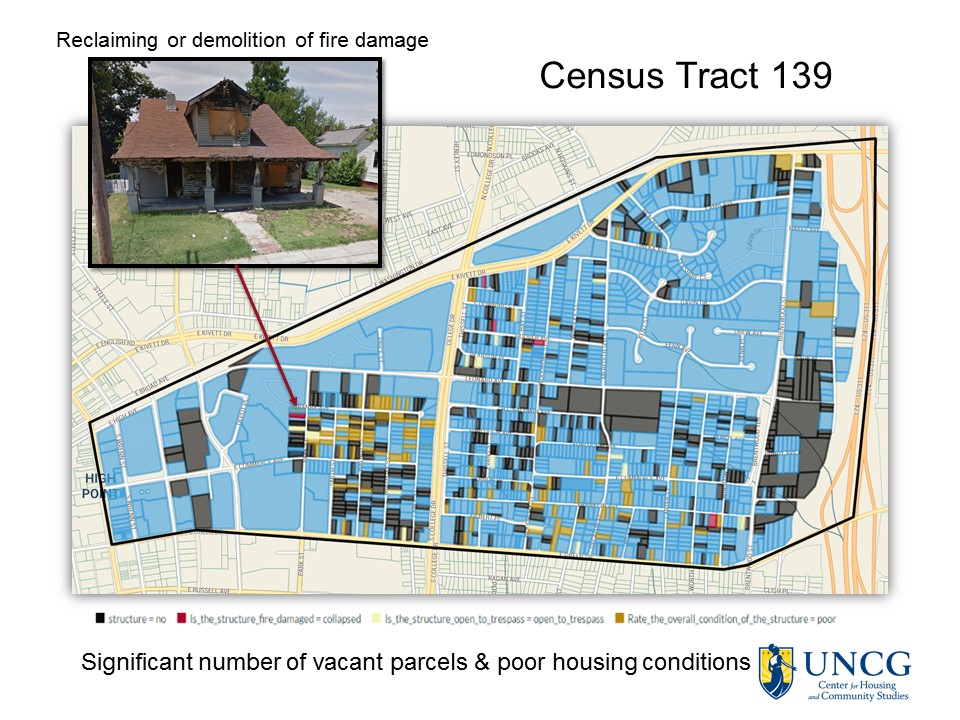
Vacant and abandoned properties are often indicative of economic distress and disinvestment in a neighborhood. Their existence presents a complex set of problems for the surrounding community, including increased crime rates, greater incidences of asthma, and decreased property values. Additionally, the presence of vacant spaces increases the likelihood of long-term, cyclic disinvestment and deterioration. Thus, revitalization efforts may be most effective when deployed in areas with high concentrations of vacant spaces. The city of High Point, North Carolina, also known as the furniture capital of the south, has experienced notable decline as manufacturing has been globalized and competing furniture trade events have opened in Las Vegas and New York. The Core City area has been especially hard hit as residential areas (many historic mill villages) were linked to manufacturing.  The area has been the subject of numerous revitalization plans since the 1960s; yet, housing and neighborhood conditions continue to deteriorate. The area is overwhelmed by substandard housing, high vacancy rates, empty lots, and affiliated low property values, high poverty rates, low homeownership rates, and high crime rates. As one-third of the total population of High Point lives in this core city area, this rate of vacancy and abandonment negatively impacts a significant portion of High Point residents. Researchers working with the Center for Housing and Community Studies (CHCS) at the University of North Carolina at Greensboro remotely gathered over 15,000 parcel-level assessments as part of a housing market segmentation study of this area. Researchers developed an external assessment tool that employed new GIS applications developed by Loveland Technologies to conduct assessments in nine census tracts. Researchers found high concentrations of vacant and abandoned properties in some of the surveyed census tracts. This data was then overlain with geospatial data from the U.S. Census, HUD, EPA, and the City of High Point to evaluate the specific effects of these vacant and abandoned properties in the local community. The findings of this project will be used to target redevelopment efforts and improve its distressed communities. This paper will review the literature on reclaiming vacant properties, examine the parcel-level data produced in the study, and review best-practices for market stabilization and revitalization in small/medium sized towns with limited resources.

Posted on April 19, 2016

Featured Image for Social Change and LGBTQ Housing Discrimination: Interpretations of the Impact of Obergefell v. Hodges on Local Fair Housing Ordinances

Joyce Clapp, CHCS Research Associate at the Southern Sociological Society

Social change has proven rarely to be a neat and orderly process of evolution, especially as it concerns civil and human rights. This paper observes the recent changes and challenges of LGBTQ housing equality in the United States.  According to the U.S. Department of Housing and Urban Development (HUD) sexual orientation and gender identity are not yet protected classes for home seekers under constitutional amendments or federal law, though recent HUD rules established under the administration of President Obama disallow LGBTQ discrimination in any housing transaction involving federal funds. This still leaves many LGBTQ home seekers vulnerable to discrimination in typical home-buying or rental markets. In this paper, we will document the history of Fair Housing laws as they pertain to sexual orientation, gender identity, and sexuality and examine how social change has occurred as both  “bottom-up” and “top-down” processes. We will demonstrate that prior to Obergefell v. Hodges, some particularly progressive states, counties, and municipalities enacted Fair Housing ordinances providing protection from housing discrimination for these statuses especially as marriage equality become a more mainstream political and social issue. For example, in January 2015, five months before the historic Supreme Court ruling providing legal rights to marry in all states, Greensboro, North Carolina became the first city in the state to add protection from housing discrimination for gay, lesbian, bisexual, and transgender homeseekers .  Yet, much like the evolution of marriage equality laws before, LGBTQ Fair Housing rights have been considered to be a local matter more than a federal one, and protection has been both piecemeal and inconsistent from place to place.

Posted on March 01, 2016

Featured Image for Woodmere Park Neighborhood Assessments
PIC11399 Spring Campus Photos 2017: general views, Public,

The proposal for this project was developed by CHCS in response to a request by Community Housing Solutions. The project involved conducting a housing conditions survey and background study of Woodmere Park Neighborhood (census tract 127.05) in Greensboro NC for the purposes of providing data for prioritizing selection of properties to be targeted for their Sept 19th “Paint the Town” Event. Project goals included:

  1. Developing a comprehensive housing hazard assessment instrument to meet the needs of Community Housing Solutions
  2. Creating rank-ordered needs maps clearly identifying individual properties in need of assistance that will help Community Housing Solutions in planning the fall event as well as subsequent housing rehabilitation efforts in Woodmere park
  3. Providing university researchers with comparable, complete, valid, and reliable data for ongoing scholarly housing research that may be shared with other community partners and translated into best practice models for other communities

The first stage of the project was to conduct a historical analysis of Woodmere Park Neighborhood, followed by analyzing statistical and geo-spatial data from a variety of existing national and local data sources and reports. CHCS then conducted primary data collection in the form of a parcel-level housing stock assessment for 1400 parcels in the Woodmere Park Neighborhood using Loveland Technologies software. This data was used to create a map of the neighborhood indicating potentially distressed properties, which included owner information as well as up-to-date tax assessor’s data.

See findings and the entire report here: Woodmere Park FINAL

Posted on November 18, 2015

Featured Image for Market Segmentation Study