Posted on October 15, 2015

Featured Image for Market Segmentation Study

City of High Point

The Center for Housing and Community Studies is working with the City of High Point on a five-month study that will inform targeted redevelopment in the City Core.

The primary focus of the Market Segmentation Study is the creation of a neighborhood condition index for High Point based on measures of neighborhood stability. Market segmentation study involves a process of evaluation which delineates spatial areas according to implicit geographic bounds and by demographic, social, economic, political, and cultural divisions. Employing established means of market segmentation analysis, the target market is being categorized into two or more groups.

 The analysis will rely on data from the individual, parcel and neighborhood levels. Resident-level data such as age, gender, race, educational background and other characteristics allow us to discern categorical groupings within a defined geo-spatial area. Secondly, parcel-level information regarding housing characteristics, including sales volume, price trends, investor purchasing, foreclosures, vacancy and abandonment add another dimension of analysis. Inclusion of neighborhood-level factors such as crime rates, occupant transience, supermarket access, socioeconomic vulnerability, components of social capital and HUD opportunity indices further enhance the detail and scope of market segmentation analysis.

Multiple sources of existing data and reports are being used to provide a foundation for the project. Additional secondary data will be collected with assistance from the IT Department at the City of High Point. Primary data sources include:

  • National Sources: The American Housing Survey, Decennial Census, American Community Survey, Home Mortgage Disclosure Act (HMDA), US Postal Service, ESRI data and HUD Tools, among others.
  • Local Sources: Guilford County tax records, foreclosures (registrar of deeds), crime data, housing code enforcement data and utility shut-offs, among others.

The Center for Housing and Community Studies has also completed primary data collection in the form of a parcel-level housing stock assessment. These data include qualitative visual and quantitative variable assessments of parcel and housing characteristics for more than 15,000 properties located in the Core City target area. In the near future, these assessments will to be conducted across the entirety of High Point and Guilford County.

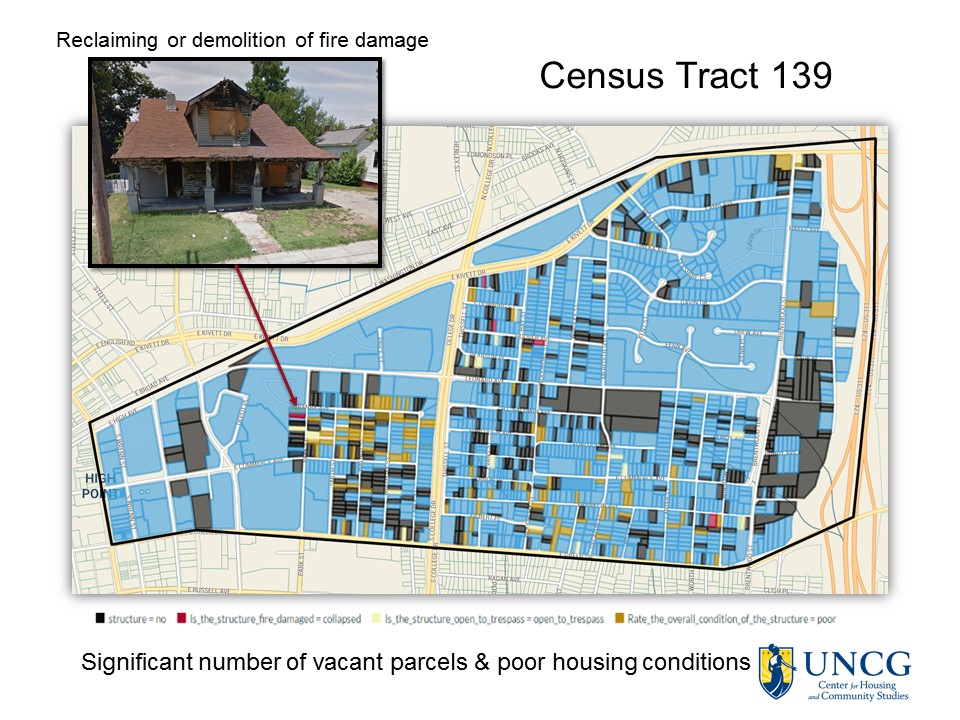
A sample of selected findings noted in initial analyses reveal that nearly 30% of structures throughout the study area show some measure of deterioration or visible damage. Among these structures, nearly 5% showed evidence of fire damage. Nearly 7% of damaged structures were boarded and secured, yet 2.2% were open to trespass. Overall structural condition ratings reveal that approximately 73% were rated as in “good” condition, 21.7% were rated “fair,” and 5.2% were rated “poor.” Thirty-one properties (0.3%) were extensively damaged and recommended for demolition. Among all properties, approximately 90% appeared to occupied. A little less than 5% clearly appeared to be unoccupied and the remaining 5% showed signs of questionable occupancy. 

We are in the process of conducting spatial analyses using these data within a geographic information system (ArcGIS) to provide a housing stock profile for the City of High Point. This analysis will include the creation a five-level typology used to identify and characterize high risk/poor condition areas as well as high opportunity areas, at both neighborhood and sub-neighborhood scales. The market segmentation analysis model employed for this study has been adapted from one implemented by the City of Youngstown, Ohio and is well-suited to the goals of the High Point Core City project. The final report will clearly identify the following neighborhood and sub-neighborhood segments:

  1. Stable/Strong Neighborhoods
  2. Functional and Constrained Neighborhoods
  3. Weak/Very Weak Neighborhoods

A version of the analysis will be made publicly available via ArcGIS Online, including an online parcel-level map of the assessment areas.

For more information about market segmentation, housing stock profiles, and redevelopment studies in your area contact Dr. Stephen J. Sills at chcs@uncg.edu

Posted on October 09, 2015

Featured Image for Summary of Healthy Homes and Neighborhoods Literature

Healthy Homes & Neighborhoods

A Review of Scholarly Literature

The Center for Housing and Community Studies

of the University of North Carolina at Greensboro

Conducted and Edited by Andrew Byrum and Lynn Cochran

Summary provided by Rebecca Harrelson

This literature review was conducted over a two-month period in early 2015, by Andrew Byrum and Lynn Cochran, research assistants working with the UNCG Center for Housing and Community Studies. It focuses on key variables involved in the complex dynamics of housing, neighborhoods, communities and health. Areas of focus include childhood asthma, lead exposure, cancers, the negative effects of living in proximity to vacant lots, boarded homes, and high-density traffic areas, and premature death. In reviewing more than twenty scholarly academic research articles within these focus areas, the reviewers found repeated correlations between poor housing conditions and health outcomes. What follow are highlighted points of the research findings which demonstrate how the spaces and places in which we live directly affect our health.     

Jacobs (2011) identified several statistically significant correlations between housing conditions and childhood asthma. In New York City, hospitalizations for children with asthma were associated with residence in the Census tracts with the highest proportion of crowded housing conditions, the largest number of racial minorities and high levels of neighborhood-level poverty. Jacobs (2011) also cites Centers for Disease Control and Prevention data from 2007 which indicated that racial and economic residential segregation was significantly associated with substandard housing conditions and negative health outcomes. Additionally, racial minorities, ethnic minorities, and families living below the federal poverty line were found more likely to live substandard housing conditions than Whites and more affluent Americans.

Read and Tsvetkova (2012) conducted an interdisciplinary review of existing literature concerning the larger contexts of housing affordability and its links to educational attainment, crime rates and health care. Their goal was to identify innovative ways in which affordable housing can promote education, safety and health, as well as profits for developers and the general real estate industry. The authors concluded that housing affordability is a multidimensional concept, one that includes facets of home and neighborhood quality, private home ownership, the public housing domain and homelessness, each with identifiable links to educational success, crime/safety, and health. On the basis of their findings, they argue for increased awareness and action at the policy and institutional levels regarding health and housing in the public sector, as well as greater awareness and efforts in the private sector to produce and maintain more affordable housing.

In 2006, Turyk et al. set out to investigate associations between parental-reported asthma morbidity in children and the presence of specific bedroom allergens (mold, cockroaches, dust mites, and cat allergens) in the homes of low-income families. The households surveyed were largely those of racial and ethnic minorities (Black and Puerto Rican families). The researchers collected allergen samples from the bedrooms of 61 asthmatic children, aged 3-13 and compared the presence of the triggers with self-reported asthma morbidity. Specifically, the researchers found that bedroom cockroach allergens corresponded with a higher number of asthma symptoms, while bedroom mold (specifically Penicillium) allergens corresponded with increased frequency of asthma symptoms.

In a later study, Garvin et al. (2013) explored how the prevalence of vacant lots and vacant homes impacts three domains of neighborhood health – physical, psychological and community well-being. Their goals included identifying what might be the most effective community-based intervention methods for dealing with blighted properties. They conducted 50 incentivized, semi-structured interviews in Philadelphia, gaining insight into local perspectives on both the character of vacant neighborhood lots as well their perceived consequences for physical and mental health. The researchers found that vacant spaces adversely impacted neighbors’ health by serving as unofficial dump sites (rotting trash build-up) that attracted rodent, animal and insect pests and by posing physical dangers (building collapse or fire). Participants also described heightened fears of crime and generalized anxiety. Participants offered numerous suggestions for eliminating vacant spaces – building subsidized housing on vacant lots, creating homeless shelters, playgrounds, and community gardens, among others. Importantly, community members expressed a strong desire to take responsibility for cleaning up their own neighborhoods, but felt they need support from local governments to be empowered to do so.

Regarding the links between ethnic and racial minority status, Apelberg at al. (2005) evaluated the racial and socioeconomic make-up of cancer risk disparities resulting from differing amounts of air toxin exposure in Maryland. The researchers conducted secondary data analysis using risk estimates from the U.S. Environmental Protection Agency’s National Air Toxics Assessment (NATA) paired with racial and socioeconomic characteristics of census tracts in Maryland (from the 2000 Census) to search for any socio-demographic correlation or association to cancer risk. They found that residents of Census tracts in the most segregated, predominantly African-American locales were three times more likely to be at high risk than those in more integrated areas. Indeed, cancer risk sharply decreased as the proportion of white residents in the census tract increased.  

In exploring the problem of childhood lead poisoning, Kim et al. (2002) researched potential associations between housing age, housing value and blood lead levels in children in Jefferson County, Kentucky. Employing secondary data analysis of blood lead level incidence reports provided by the Kentucky lead poisoning registry, the authors mapped the data by address, relating it to property ages and values recorded in the Jefferson county tax database. They found that children living in older homes and/or in homes valued less than $50,000 were statistically more likely to have elevated blood lead levels. Strikingly, home and property value was more strongly associated with lead poisoning risks than was the age of local housing stock.

There now exists a growing narrative on the complex and multidimensional relationships between socioeconomic status, race and ethnicity, housing and neighborhood conditions, and individual health. This research review summarizes but a snapshot of these relationships. Yet, when considering these in an even larger perspective, one that also accounts for transportation limitations and barriers to local health care access, the evidence for cyclical and systemic health inequities across large sectors of the American populace, living in a diversity of spaces and places is overwhelming.

To read the full literature review visit Health and Housing Literature Review

Posted on September 21, 2015

Featured Image for Greensboro’s New Housing Code Policy

By: Beth McKee-Huger (Community Housing Advocate)

On September 1, 2015, Greensboro City Council adopted changes to the city housing ordinance, Chapter 11 of the municipal codes, with the purpose of preserving housing by turning around unsafe housing conditions as quickly as possible.  Please share the following information with tenants, rental property owners, and homeowners so that everyone will understand responsibilities and the city requirements.

Responsibilities of property owners:

  1. Maintain housing in safe condition to meet minimum safety standards.
    1. All plumbing, electrical, heating, cooling, and appliances must work.
    2. The building must be structurally sound, without leaking roof or deteriorating walls or floors.
    3. Porches and stairs must have railings if 30” inches or more from the ground.
    4. Housing must be pest-free when occupants move in; owner must control pests in multi-family housing.
    5. Windows & doors must open (in case of fire) and lock (for security).
  2. Provide utility services that the lease specifies are in the owner’s name.
  3. Do not rent housing that is condemned or under an Order to Repair.

Responsibilities of occupants:

  1. Prevent damage to the building; do not put anything in the toilet; keep the housing unit clean and dispose of garbage. Occupants must control pests in single family houses.
  2. Connect and maintain utility services that the lease specifies must be in the occupant’s name.
  3. Do not use unsafe heating equipment, such as unvented kerosene heaters or space heaters. Do not use generators or gas or charcoal grills inside a house or apartment.
  4. Notify the owner, in writing, of repair needs.

Code enforcement process by city inspectors to encourage prompt repairs:

  1. Request for inspection: call 373-2111 or make an online request by going to http://www.greensboro-nc.gov/index.aspx?page=1594 and click on Email. Inspectors may also initiate an inspection when they note 5 or more exterior violations or if the owner has a history of uncorrected code violations.
  2. Inspection: inspector contacts occupant and owner to enter the housing unit and write up any code violations found. If necessary, inspector can obtain an Administrative Warrant to gain access.
  3. Hearing: city notifies owners, occupants, and other parties of interest of hearing for inspector to explain violations and processes.
  4. Order to Repair or Demolish: the order is issued with specific deadline for correcting violations (30 days). Before the deadline, owner can submit a written request for time extension to complete repairs and receive a written response specifying the new deadline.
  5. Re-inspection after deadline: inspector re-inspects the housing unit; if all violations have been repaired the case is closed with no penalty. If violations remain, the housing unit is ordered vacated, a condemnation sign is posted, and a $200 civil penalty is issued plus $10 per day of noncompliance.
  6. Next re-inspection: if violations are corrected, the case is closed and daily fines stop. If there are still violations, another re-inspection fee is charged and the case is referred to the Minimum Housing Commission with recommendation for an Order to Repair (if repairs are estimated to be less than 50% of tax value) or an Order to Demolish (if repairs are more than 50% of value).  Owners who rent a condemned housing unit can face additional civil penalties.
  7. Minimum Housing Commission hearing: the owner has the opportunity to present a plan for repairs. The Commissioners then vote to extend the time or to order repairs or demolition in 90 days. If the owner does not repair or demolish in 90 days, the city will repair (if less than 50%) or demolish (if more than 50%) and place a lien on the property for these costs.
  8. Liens: if the owner does not pay the repair or demolition costs, the city can foreclose on the lien and sell the property to recover the costs.

Posted on August 31, 2015

Featured Image for CHCS Upcoming Canvassing Dates and Details

Inclusive information on upcoming CHCS canvassing dates

Rebecca Harrelson

No one should be living in unsafe housing conditions in Greensboro NC. Especially when we have able bodies to rid others of this burden. The UNCG Center for Housing and Community Studies is conducting a study to identify residents in low income neighborhoods who may need assistance in maintaining or improving the conditions of their homes.

The CHCS is putting together a team of Greensboro community members to canvass different neighborhoods in the Greensboro area.

The team will be asking residents about the conditions of their home:

– Have any problems with the electrical wiring?

– Any small kids in the home?

– Feel safe in your home?

– Do you require grab bars in the bathroom?

Why get involved? By volunteering a couple hours of your weekend you are giving back to your community. You are building relationships with your neighbors. You are allowing yourself the opportunity to grow and improve your community. Starting these conversations with community members go further than CHCS but builds a better Greensboro.

The dates for the upcoming canvassing:

– September 12th – Glenwood

– October 10th ( Tentative ) Southside High Point

– November 14th ( Tentative ) Cottage Grove

– December 5th ( Tentative ) MLK/Old Asheboro

The research we are conducting will be used to help the elderly and low-income populations of Greensboro live healthier and stress free lives. If you want to be a part of this grassroots effort, need more information, contact Zechariah Etheridge at zcetheri@uncg.edu. CHCS looks forward to hearing from you!

Posted on July 07, 2015

Featured Image for Yes! Weekly: Layers of Data

On June 17, 2015, Jeff Sykes wrote about the CHCS in Yes! Weekly: 

“Community groups like the Greensboro Housing Coalition, Cone Health System, and others, possess mountains of data showing a connection between substandard housing, environmental conditions and poor health, but it’s often difficult to translate the data for policy makers and grant proposals.

“A new research center formed this year in the Office of Research and Economic Development at UNC- Greensboro, however, is using an interdisciplinary team of social scientists and geographic information systems to harness the power of that information.”

Read the story here.

Posted on July 07, 2015

Featured Image for CHCS Feature Article in Yes! Weekly

Layers of Data – By Jeff Sykes June 17, 2015

https://yesweekly.com/LAYERS-OF-DATA-a23073/

“The Center for Housing and Community Studies, formed under the leadership of Stephen Sills, a sociology professor with a long track record of housing research, is aggregating data from a variety of sources into geospatial maps with the potential to do much more than just paint a picture.”

Posted on July 01, 2015

Featured Image for Piedmont Triad Fair Housing Equity Assessment

Click here to read the executive summary of the Piedmont Triad North Carolina Regional Fair Housing Equity Assessment. 

Posted on May 15, 2015

Featured Image for The Battleground of Housing in the South

Housing has quickly emerged as a battleground in the debates and struggles around social justice and inequality. The preceding anecdotes, collected by the Immigrant Assistance Center of FaithAction International House, the researchers for the Strategic Study of the State of Human Relations in Greensboro Report, the Greensboro Housing Coalition, and the researchers of the Center for Housing and Community Studies exemplify some of the housing issues facing Latinos in North Carolina. When minorities find their residential mobility blocked because of discrimination, it creates a barrier to spatial assimilation, a key component to socioeconomic and occupational mobility.

Posted on May 15, 2015

Featured Image for Racial Segregation in the Piedmont

Both a casual observation of our neighborhoods and recent Census data reveals that we live in a racially segregated region. The few studies that have been done suggest that discrimination is responsible in part for this segregation. A measure of segregation is found in the dissimilarity index. This index (also known as a Gini coefficient) measures the relative separation or integration of groups across all neighborhoods of a city or metropolitan area. If an area’s white-black dissimilarity index were 65, that would mean that 65% of white people would need to move to another neighborhood to make whites and blacks evenly distributed across all neighborhoods. Based on U.S. Census data provided by HUD for the Piedmont Region, we see that the Piedmont region is moderately to highly segregated.

Residential racial segregation emerged in America between 1900 and 1940 (Massey and Denton 1993; Farley and Frey 1994). In this period, over a million black Southerners migrated to cities in the North on the promise of better-paying industrial work (Hahn 2003; Wilson, 1978). In the South, the Jim Crow system governed the terms of interracial contact by subordinating blacks and enforcing strict public separation of the races, but it did not create or enforce residential segregation (Massey and Denton 1993). Segregation levels were lower in 1900 then than they are now (Farley and Frey 1994). In the North, with no such system in place, working-class whites responded with alarm to the rapid influx of potential competitors, and increasingly used violence and threats to keep the new arrivals contained in less desirable housing and jobs (Massey and Denton 1993). Between 1900 and 1921, white mob attacks and riots directed against blacks were followed by a wave of bombings aimed at black homes and offices. As the violent trend crested, whites increasingly turned to more institutionalized methods to exclude minorities (Massey and Denton 1993).

Massey and Denton (1993) provide a comprehensive review of the strategies used by white homeowners to formalize the exclusion of blacks from their neighborhoods. Middle-class homeowners formed “neighborhood improvement associations” and other voluntary property owners’ corporations, ostensibly to promote security and property values, but with the implicit purpose of preventing black entry into their neighborhoods. They lobbied city councils for zoning restrictions and the closing of businesses that attracted blacks, and they pressured real estate agencies to support their agenda. They implemented restrictive covenants, which were contractual agreements binding property owners to sell only to whites, and they pressured neighbors who were reluctant to sign. Restrictive covenants spread widely throughout the country after 1910, often under the leadership of local real estate boards.

Beginning in 1910, Southern cities began the use of municipal ordinances establishing separate black and white neighborhoods. In 1916, the Supreme Court found these ordinances unconstitutional, and in 1948, another Supreme Court ruling declared restrictive covenants unenforceable. Civil rights historian William Chafe (1980) noted that in Greensboro, NC, where our study takes place, there was a city ordinance on the books from 1914 to 1929 that prohibited blacks from living on streets that contained a majority of white households. As late as 1967, more than 90 % of Greensboro’s black residents lived in the southeast quadrant of the city, an area covering only 14 % of the city’s space, hemmed in by infrastructural barriers including an interstate highway, an industrially-zoned district, and the commercially-zoned downtown area. This same area today continues to show its history of segregation and fits HUD’s definition of a racial concentration of poverty.

Posted on May 14, 2015

Featured Image for Fair Housing Equity Assessment Executive Summary
PIC11399 Spring Campus Photos 2017: general views, Public,

Piedmont Triad North Carolina Regional Fair Housing Equity Assessment Executive Summary prepared for The Piedmont Triad Sustainable Communities Regional Planning Project.

2013-piedmont-triad-fhea-executive-summary